There’s maybe one thing that would make an adorable furry cat even cuter…Ringlets! Curly hair cat breeds are very real, very adorable, and yes, they look like tiny sheep in the most dignified way possible.

Curly haired cats are rare compared to your average domestic shorthair, but they’ve quietly won the hearts of cat lovers all over the world. Whether you’re a first-time cat parent or someone who already plans your vacations around your feline’s feeding schedule, these curly-coated beauties deserve a spot on your radar.
Let’s talk about what makes them curly, which breeds have those signature waves, and whether one might be the perfect addition to your cat-loving household.
Why Do Some Cats Have Curly Fur?
Curly hair in cats is caused by a natural genetic mutation that affects the structure of the hair shaft. Many of these breeds fall under what’s known as “rex” cat breeds. The term “rex” refers to that distinctive wavy or curly coat.
Different rex breeds have different types of curls. Some have tight, uniform waves that feel like velvet. Others have loose, plush ringlets that look like they belong on a stuffed animal.
A few quick myths to clear up:
- No, they are not part poodle.
- No, they did not get a tiny salon perm.
- Yes, they are naturally this fabulous.
Because these coats are genetically different, they also behave differently when it comes to shedding and grooming. Some curly fur cats shed less than typical cats, but none are completely non-shedding.
The Most Popular Curly Hair Cat Breeds
There are four main curly hair cat breeds recognized by major cat associations, The International Cat Association (TICA) and The Cat Fanciers Association (CFA). Each one has its own look and personality, so let’s break them down.
Devon Rex

The Devon Rex looks like it was designed by someone who said, “Let’s make it whimsical.” With oversized ears, a pixie-like face, high cheekbones, and short, soft waves, they are instantly recognizable. In fact, the breed first appeared in England in the 1960s, and ever since then people have been asking, “Is that a cat or a tiny gremlin?” In the best way possible, of course.
Their coat is fine and delicate, often described as suede-like or similar to crushed velvet. Unlike most cats, their fur lacks the usual guard hairs, which gives it that soft, rippled texture. Because the hair is fragile, over-brushing can actually damage the curls and cause bald patches. Most Devons need only gentle grooming, an occasional wipe-down, and regular ear cleaning since those adorable satellite-dish ears can collect oil more quickly than other breeds.
Living with Devon Rex:
Personality-wise, they are famously social, smart, and quite naughty. Devon Rex cats consistently rank among the most people-oriented breeds, and many owners say they behave more like dogs than typical cats. If you want a cat that follows you from room to room, supervises your laundry folding, taste-tests your dinner, and insists on sitting on your shoulder while you work, this might be your breed. They are often called “Velcro cats” for a reason. Don’t bother shutting the bathroom door, they will insist on joining you.
They are also incredibly intelligent and curious. Puzzle toys, interactive feeders, and clicker training are not just nice extras for a Devon Rex. They are highly recommended unless you want your cat inventing their own entertainment (which may include opening cabinets or learning how doorknobs work!).
Shedding level is generally low. Devon Rex cats tend to produce less loose hair due to their fine coat structure, which can mean fewer tumbleweeds of fur rolling across your floor. However, they still produce dander, so allergy sufferers should always spend time with one before committing. Some people with mild allergies report fewer symptoms, but reactions vary from person to person.
Devon Rex cats are best for cat parents who want an affectionate, playful companion that acts like a permanent toddler with whiskers and has zero interest in respecting personal space.
Cornish Rex
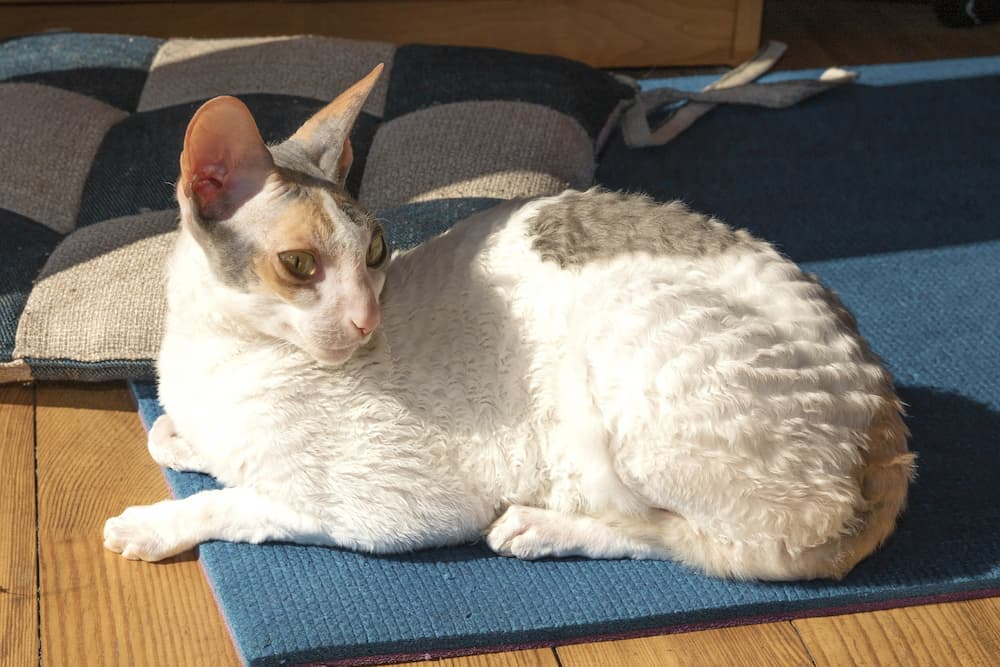
The Cornish Rex is sleek, athletic, and covered in tight, uniform waves that look like they were sculpted by a tiny feline hairstylist. The breed originated in Cornwall, England in the 1950s, and ever since then they have been turning heads with their elegant, almost greyhound-like build. What makes them truly unique is that they only have the undercoat layer of fur. Most cats have three layers of hair. The Cornish has just one, which creates that signature soft ripple effect and gives them their incredibly refined appearance.
Because of this single-layer coat, they feel unbelievably soft to the touch. Think warm velvet, heated fleece blanket, the softest throw pillow in your house that your cat has already claimed as their own.
Living with Cornish Rex:
When it comes to their personalities, Cornish Rex cats are basically tiny, curly athletes. They’re energetic, agile, and always ready to launch themselves onto the highest available surface. They don’t simply jump onto counters, they spring. They don’t casually stroll down hallways, they zoom. Many breed experts describe them as one of the most active domestic cat breeds, and owners often joke that they never truly grow out of their kitten phase.
If your house already resembles a feline jungle gym with cat trees, shelves, and climbing posts, a Cornish Rex will consider it an obstacle course designed specifically for them. Interactive toys, puzzle feeders, and daily play sessions are not optional. They are required unless you want your Cornish inventing parkour routines at 2 a.m.
Shedding is very low compared to many other breeds, which can be a nice bonus for tidy households. However, their thin coat also means they get cold easily. Do not be surprised if your Cornish decides your lap is now a permanent heating pad and any sunny patch on the floor belongs exclusively to them. In cooler climates, some owners even provide cozy beds or soft sweaters for extra warmth.
Cornish Rex cats are best for active households, multi-cat families, and anyone who appreciates a playful, affectionate cat with endless energy and a slightly dramatic flair.
Selkirk Rex

If the Devon and Cornish are sleek and wavy, the Selkirk Rex is the teddy bear of curly cats. Their coat is plush, thick, and full of loose ringlets that look like they were styled with a tiny curling iron. In fact, this breed is often nicknamed “the cat in sheep’s clothing” because those soft curls can make them resemble a living stuffed animal. They come in both short and long hair varieties, and both versions bring serious volume.
The Selkirk Rex originated in the United States in the late 1980s, making them the newest of the rex breeds. Unlike the other rex cats, the Selkirk carries a dominant curly gene, which means their signature ringlets are more consistently passed down genetically. In simple terms, when a Selkirk has kittens, the odds of adorable curls are delightfully high.
Living with Selkirk Rex:
Personality-wise, Selkirks are the laid-back sweethearts of the curly cat world. They tend to be calm, patient, and deeply affectionate without being overly demanding. Think gentle companion rather than chaotic acrobat. Many owners describe them as easygoing and adaptable, which makes them wonderful for families with children, multi-pet households, or first-time cat parents who want a predictable temperament. They are playful, but they won’t be scaling your curtains at midnight. They prefer a cozy couch and a reliable lap.
Because of their thick, dense coat, grooming is a bit more hands-on than with the finer-coated rex breeds. Selkirks require regular brushing to prevent tangles and matting, especially the long-haired variety. A wide-tooth comb works best to preserve those curls without turning your cat into a fluffy puffball. Bathing is occasional, not frequent, but their coat does benefit from consistent maintenance to keep it soft and healthy.
Shedding level is moderate, particularly in long-haired Selkirks. While they are not heavy shedders compared to some long-haired breeds, you will still find fur on your black leggings from time to time. If you’re hoping for completely low-maintenance grooming, this may not be your perfect match. If you don’t mind combing sessions that double as bonding time, you will likely find it worth it.
Selkirk Rex cats are best for families who want a cuddly, sweet-natured companion with serious curl appeal and a personality that feels as warm and comforting as their plush coat.
LaPerm
The LaPerm is known for its soft spiral curls, often most noticeable around the neck, belly, and tail. The breed originated in Oregon in the early 1980s when a barn cat gave birth to a kitten that was born completely bald. A few weeks later, that kitten sprouted a coat of bouncy curls and accidentally launched an entire breed. Talk about a glow-up!
Kittens are sometimes born bald or with straight fur that later turns curly, which means bringing home a LaPerm can feel a little like waiting for a surprise ending. Around 8 to 12 weeks, many develop their signature waves, and some even go through coat changes during their first year. It keeps things interesting.
Their coat can range from light waves to full ringlets, and it has a slightly springy texture that feels airy rather than dense. Unlike the plush Selkirk, the LaPerm’s curls are usually lighter and more separated, giving them a relaxed, slightly tousled look. Grooming is generally simple. A gentle brush or comb once a week is usually enough to prevent tangles and keep the curls defined. Over-brushing can make the coat frizz out, which is adorable but not technically the goal.
Living with LaPerm:
LaPerms are affectionate and curious without being overwhelming. They love spending time with their humans, whether that means sitting beside you on the couch, supervising your laptop work, or quietly observing from a nearby perch. They are social but not typically as clingy as some rex breeds. Think loyal companion rather than full-time shadow. They strike a lovely balance between playful and relaxed, making them adaptable to both busy households and quieter homes.
Shedding tends to be low to moderate, depending on coat length, and many owners find it manageable compared to heavier-coated breeds. As always, individual cats vary, but LaPerms are generally considered easy to maintain.
LaPerms are best for cat parents who want a rare, adaptable breed with a softer energy, a sweet temperament, and curls that look effortlessly chic without trying too hard.
Are Curly Haired Cats Hypoallergenic?
The truth is that no cat is truly hypoallergenic. Allergies are typically triggered by a protein called Fel d 1 found in saliva and skin secretions, not just the fur itself. However, some curly hair cat breeds shed less due to their unique coat structure. Less loose hair can mean fewer allergens floating around your home, but this varies from cat to cat.
If you have allergies, the best approach is simple:
- Spend time with the specific breed before you commit to bringing one home.
- Visit a home that already has one, such as a trusted owner or reputable contact who allows meet-and-greets in a home setting.
- See how your body reacts before bringing one home.
- Consider allergen-reducing supplements for your cat, such as Pacagen, if you have mild allergies and want extra support.
Are Curly Hair Cat Breeds Rare?
Yes, compared to the average mixed-breed house cat, curly hair cat breeds are relatively uncommon.
Curly-haired cats make up a small percentage of registered pedigreed cats each year, and that rarity can have an impact on price. While prices vary widely based on breeder reputation, location, lineage, and more, you might expect to pay $800 to $2,000 or more for these fancy-fur babies. But these curly cuties are priceless if your heart melts at first sight! Always look for ethical breeders who perform health testing and prioritize temperament.
Occasionally, curly-coated kitties show up in rescue organizations. If you are open to adoption, keep an eye out.
Is a Curly Fur Cat Right for You?
You might fall in love with a curly cat if:
- You adore unique-looking breeds.
- You enjoy interactive, social pets.
- You don’t mind learning about specialized grooming.
- You want a cat that will absolutely be the conversation starter at every gathering.
You might reconsider if:
- You prefer a very independent cat.
- You want zero grooming responsibility.
- You are expecting a guaranteed allergy-free experience.
As with any breed, the best choice is one that matches your lifestyle and energy level.
Final Thoughts on Cats with Curls
Curly hair cat breeds are charming, affectionate, and undeniably eye-catching. Whether it is the pixie-faced Devon Rex, the athletic Cornish Rex, the plush Selkirk Rex, or the softly spiraled LaPerm, each brings something special to the table.
But here is the most important truth of all: Straight fur, curly fur, fluffy fur, or barely-there fur, your cat will still wake you up at 5 a.m. demanding breakfast! The love is the same, the curls are just a bonus.
If you have a curly-coated companion at home, we would love to hear about them. And if you know a fellow cat parent who needs to learn about these fabulous felines, share this article with your cat-loving friends and spread the curl appreciation. For more breed guides, care tips, and cat-obsessed content, keep reading The Catington Post. Because when it comes to cats, there is always more to discover.